
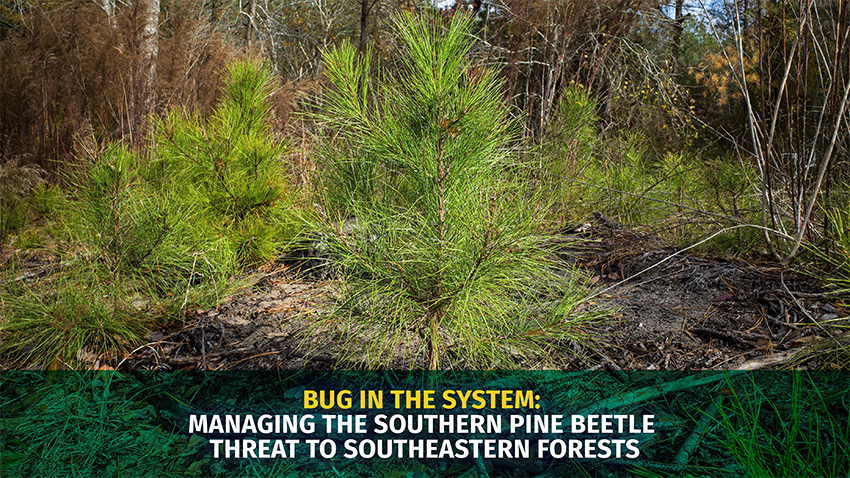
Recent reports of Southern Pine Beetle (SPB) outbreaks have raised alarms across the southeastern United States, with many forested areas suffering high levels of tree mortality. In Alabama, the state’s forest management agency reported in late August that the SPB problem is the worst it’s been in more than 20 years. As such, the Alabama Forestry Commission has issued an alert highlighting almost 5,000 trouble spots. The beetles have killed an average of 191 trees at each location.In the past few years, newspapers and research papers have highlighted the increasing frequency of SPB infestations, drawing attention to this tiny insect’s devastating impact on southern forests. SPB activity has surged as climate change alters regional temperatures and humidity levels. In states like Alabama, Georgia, and South Carolina, where forestry plays a critical role in local economies, the rising infestation is an urgent issue requiring a coordinated response.Little Critters Carry a Huge Price TagThe Southern Pine Beetle is a small insect wielding a gigantic economic punch. According to estimates, SPB outbreaks cost the timber industry millions annually. One outbreak across several southeastern states resulted in over $1 billion in timber losses from 1998 to 2000. However, the economic impact goes beyond the timber industry, affecting local economies that rely on logging and other forestry-related industries.The ecological cost is equally troubling. Pine forests serve as critical habitats for many species, and when these trees die off en masse, it disrupts local ecosystems. Dead trees lose their value as timber and become fire hazards, increasing the risk of catastrophic wildfires. The long-term cost of SPB damage includes losing biodiversity and dampening positive ecosystem outcomes such as carbon storage and water filtration, which forests naturally provide.What Is the Southern Pine Beetle?The Southern Pine Beetle (Dendroctonus frontalis) is a native bark beetle found in the southeastern United States. These beetles are small, only about 3 millimeters long, but they are capable of killing large numbers of pine trees when their populations explode during outbreaks. The beetles attack various pine species, including loblolly, shortleaf, and Virginia pines, which are common in southern forests. The SPB typically targets weakened or stressed trees, although, during large outbreaks, even healthy trees can fall victim.SPB beetles bore into the bark of pine trees, creating tunnels where they lay their eggs. The larvae that hatch then feed on the inner bark, disrupting the flow of water and nutrients throughout the tree. The beetle and their larvae eventually kill the tree, leaving behind characteristic patterns of pitch tubes—resinous globules that the tree produces in a futile effort to push the beetles out.The Range and Spread of SPBThe Southern Pine Beetle is native to the southeastern United States but can be found from Texas to New Jersey and even as far north as New York during severe outbreaks. SPB populations tend to rise and fall in cycles, with outbreaks occurring roughly every 10 to 15 years. However, in recent years, the range of SPB has expanded due to warmer winters, which allow more beetles to survive and reproduce. Northern states that once were too cold to support large SPB populations are now experiencing infestations, suggesting that the beetle’s range may continue to expand as global temperatures rise.Mitigation Strategies: Controlling Southern Pine Beetle DamageManaging SPB outbreaks is challenging but not impossible. There are several mitigation strategies to limit the damage caused by these beetles:Thinning Forests: One of the most effective methods for reducing SPB outbreaks is thinning overly dense pine stands. Thinning stock creates more space between trees, making it harder for SPB populations to spread rapidly from tree to tree. It also promotes the growth of healthier, more resilient trees that are better able to resist beetle attacks.Cut-and-Remove Method: During an outbreak, infested trees can be cut down and removed from the forest to prevent the beetles from spreading. This method is particularly effective early in an outbreak before beetles can migrate to other trees.Chemical Treatments: In some cases, insecticides applied to individual trees can protect them from SPB attacks. However, this is typically only used in high-value areas, such as urban forests or parklands, due to the cost and environmental concerns of widespread chemical use.Biological Control: Researchers are also exploring natural enemies of the SPB, such as certain species of parasitic wasps, as a potential biological control. While promising, this method is still experimental and has yet to be widely used.Similar Species: How to Tell the DifferenceSeveral other beetles may be mistaken for the Southern Pine Beetle, including the Ips engraver beetle (Ips spp.) and the black turpentine beetle (Dendroctonus terebrans). These beetles also attack pine trees but are generally less destructive than SPB. One key difference is the type of damage they cause. Ips beetles typically create distinct galleries under the bark in a Y- or H-shaped pattern, whereas SPB galleries are more serpentine or S-shaped.Additionally, Ips and black turpentine beetles tend to target stressed or damaged trees rather than healthy ones, meaning their impact is usually less severe. Ips beetles also tend to colonize the upper parts of trees, while SPB can attack any part of the tree.Source: Georgia Forestry CommissionThe Future Outlook for Southern Pine ForestsThe future of Southern pine forests in the face of SPB infestations is uncertain. While forest management practices, such as thinning and early detection, can help mitigate the damage, the increasing frequency and severity of outbreaks linked to climate change present a long-term challenge. Warmer winters and extended growing seasons allow SPB populations to thrive in areas where they were once limited, pushing their range farther north each year.However, there is hope. Advances in forest management, biological control, and monitoring technology may help slow the spread of SPB. Increased awareness and proactive management are also key. Forest owners and managers must stay alert, employ early detection techniques, and take swift action when signs of an outbreak appear.In the long term, adapting forestry practices to create more resilient forests—such as diversifying tree species and using more sustainable forest management techniques—may be the best defense against the growing threat of the Southern Pine Beetle.How can your pallet provider help?When it comes to mitigating the supply chain risks posed by the Southern Pine Beetle, a reliable pallet provider like PalletOne can make a significant difference. PalletOne offers comprehensive solutions that not only ensure a steady supply of quality wood products but also educate customers on sustainable practices and proactive measures.Reliable Wood Supply: PalletOne ensures the consistent availability of high-quality pallets, minimizing disruptions even during severe SPB outbreaks. By sourcing wood responsibly and maintaining robust inventory levels, we help keep your supply chain running smoothly.Customer Education: Understanding the impact of SPB and knowing how to mitigate these risks is crucial. PalletOne provides our customers with educational resources and expert advice on key industry topics through our free blog newsletter and on LinkedIn.Sustainable Practices: We advocate for and implement sustainable forestry practices, including thinning and selective harvesting, which can reduce the vulnerability of forests to SPB attacks. These practices not only protect the environment but also ensure a continuous, healthy supply of wood.By choosing PalletOne as your pallet provider, you gain a partner dedicated to safeguarding your supply chain against the threats posed by the Southern Pine Beetle. Let us help you secure your wood supply and educate your team on effective forest management strategies. Visit PalletOne today to learn more.