Manually stacking 52.5 lb cartons of potatoes on a pallet is not a job for everyone. When Paul, ID-based Magic Valley Produce began facing significant labor shortages, particularly in its potato palletizing operations, it looked to automate. To further complicate matters, the building’s challenging two-piece potato box design and space limitations ruled out many conventional options.
The grower enlisted the help of an automation system integrator, who recommended a collaborative robot equipped with special grippers that could efficiently handle the heavy boxes of potatoes with a minimal footprint. The integration of this automation not only alleviated labor constraints but also enhanced operational efficiency.
Labor Shortages Driving Automation in Agriculture
Automation in U.S. agriculture is no longer a novelty; it’s becoming a necessity. Labor shortages, rising costs, and increasing demands for sustainability are pushing farmers to adopt technologies that improve efficiency, conserve water, and make up for a shrinking workforce. The challenges of climate variability and the growing complexity of supply chains are further driving the need for smarter, more integrated systems.
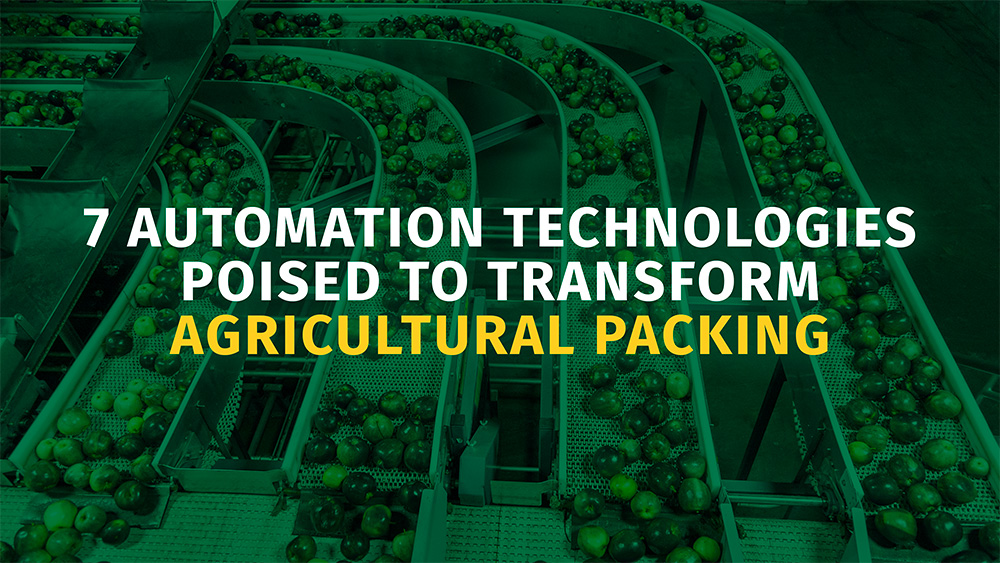
To be sure, there are barriers to adoption. Many of these technologies come with hefty price tags and may have significant learning curves. However, as labor resources become increasingly scarce, more farms are seeking fresh solutions. Here are seven automation technologies poised to make an impact on agricultural packaging operations:
1. Vision-Based Sorting and Grading Systems
Vision-based sorting and grading systems are revolutionizing post-harvest operations with their ability to assess produce quickly and accurately. Equipped with cameras, infrared, and hyperspectral imaging, these systems evaluate size, shape, color, and internal quality to ensure that only premium-grade produce reaches the packing stage.
Detecting defects and substandard items in real time minimizes waste and boosts product consistency. At the same time, they prevent the accidental culling of non-defective products. According to one report, human inspectors typically discard 10 to 20% of acceptable potatoes in error, reducing profits. Vision systems integrate easily into automated packing lines, feeding sorted produce directly into packing and palletizing systems for a seamless workflow.
2. Automated Case Packers
Automated case packers streamline the process of placing produce into cartons or crates. These systems use advanced vision technology and robotic arms to pack items carefully and consistently, handling even fragile crops like tomatoes and avocados without damage. For high-value produce, automated case packers ensure compliance with retailer specifications for packaging quality. Farms can integrate these systems with upstream sorting and grading technologies for a seamless packing operation. Case packers enhance productivity and packaging uniformity by reducing reliance on manual labor.
3. Collaborative Robots (Cobots)
Collaborative robots, or cobots, are an emerging solution for packing operations where space or budgets may limit the adoption of fully automated systems. These lightweight robots work side-by-side with human workers, performing repetitive tasks such as packing, labeling, and stacking.
Cobots are designed for safety and ease of use, with intuitive programming interfaces that allow operators to reconfigure them quickly for different tasks. Their adaptability makes them especially useful for smaller operations that handle diverse products or seasonal harvests. Cobots enhance efficiency while allowing workers to focus on more complex or value-added tasks.
4. Automated Pallet Dispensers and Conveyors
Automated pallet dispensers and conveyors are essential components of modern packing operations, ensuring the efficient movement of pallets and packed goods. Pallet dispensers automate the supply of pallets to packing lines, eliminating delays caused by manual handling. Conveyors transport goods from sorting and packing stations to palletizing systems or loading docks, maintaining a smooth and continuous workflow. For pallet handling systems to operate effectively, farms must use high-quality pallets compatible with the system. Poorly constructed or inconsistent pallets can cause jams and downtime, underscoring the importance of aligning pallet specifications with the design of the automation system.
5. Robotic Palletizers
Robotic palletizers are transforming farm packing operations by taking over the labor-intensive task of stacking boxes, crates, and bags onto pallets. These systems can quickly and consistently stack items using robotic arms equipped with precision grippers, optimizing space and stability.
They are particularly effective in handling a wide range of products, from delicate fruits to heavy vegetable sacks. Farms adopting these systems benefit from reduced labor costs, faster throughput, and minimized risk of injuries from repetitive manual stacking. Additionally, their programmability allows easy reconfiguration to accommodate different products or pallet patterns.
6. Autonomous Mobile Robots
While the near-term adoption of autonomous mobile robots (AMRs), such as autonomous forklifts, may be more limited than some of the other technologies mentioned, they are poised to play an increasingly significant role, particularly in larger and more mechanized operations.
Autonomous forklifts transport pallets of packed produce from packing lines to cold storage or loading docks without human intervention. Using advanced sensors and AI, they navigate warehouse environments safely and efficiently. This technology is particularly appealing for high-volume operations where the repetitive movement of pallets creates bottlenecks or labor strain.
Pallet quality is critical in an autonomous forklift environment to avoid obstructed pallet entry. AMRs are also beginning to play a role in the field, where they can follow manual harvesters and be easily stacked with full containers, helping eliminate picker travel time.
7. IoT and Smart Sensors
IoT and smart sensors are enabling a new level of intelligence in farm packing operations, especially when integrated with other smart automation that captures data as product moves through packing operations. These devices track key performance metrics, such as equipment efficiency, environmental conditions (e.g., temperature and humidity), and operational bottlenecks, in real time.
By providing actionable insights, IoT systems help farms optimize packing line performance, prevent equipment downtime, and ensure that produce is packed and stored under ideal conditions. IoT devices enable transparency and accountability across the supply chain when integrated with blockchain or traceability systems. As these technologies become more accessible, they are expected to drive widespread improvements in packing efficiency and quality control.
As the labor crunch intensifies, more and more growers like Magic Produce are pulling the trigger on automation. When it comes to pallet handling automation, such as dispensers, shuttles, palletizers, and automated forklifts, consistent, high-quality pallets are essential. Poor quality pallets can cause jams and delays, leading to lost productivity and additional costs.
Early conversations between farm operators, their automation integrators, and the pallet provider can help prevent such issues by ensuring optimized system design. Discussing pallet specifications during the automation design phase can prevent a lot of headaches and, once commissioned, keep your valuable automation investment up and running. If you are considering automation of your packing operations or are having pallet issues with a completed installation, give us a call today.