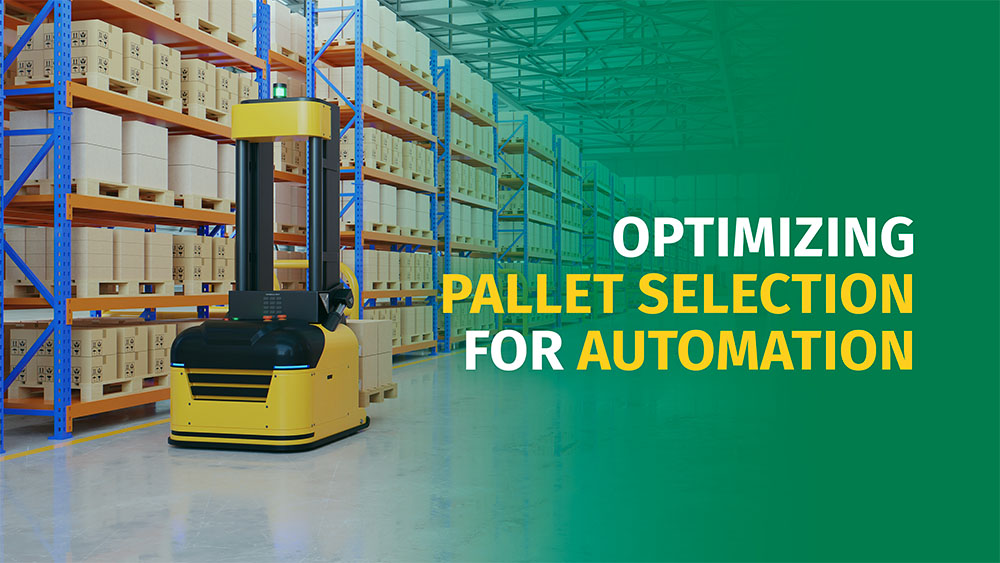
Automation is growing fast, and that will have implications for pallet selection. A recent report projects that the North American warehouse automation market will expand from $5.88 billion in 2023 to $9.33 billion this year. Generally speaking, warehouse automation requires consistently high-quality, dimensionally accurate pallets. This article examines what’s driving automation growth and what will be needed to ensure pallet optimization.
The Rapid Growth of Warehouse Automation
A variety of factors has driven the rapid growth of automation. These include:
E-commerce and rapid fulfillment: Until recently, most distribution or fulfillment centers were geared toward case picking for retail stores. However, the emergence of online shopping for single consumer units created a shift that traditional warehouses were ill-prepared to meet. Retailers have taken various approaches, including manually picking e-commerce orders from retail stores or dedicated e-commerce “dark stores” or introducing automation into existing or new dedicated warehouses.
Labor costs and flexibility: With increasing wage rates in regions like North America, automation presents a cost-effective solution to replace labor, especially during peak shipping seasons when labor shortages are common. In e-commerce, in particular, automation that brings the goods to the picker can help dramatically increase productivity by eliminating travel time. An added bonus is that worker retention is typically greater, and workplace accident rates are usually lower than at warehouses requiring manual order picking.
Tight warehouse availability: With the growth of e-commerce in particular, the result has been a shortage of warehouse space. Warehouse automation can help improve inventory density, allowing facilities to store more goods in the same facility. Legacy facilities can also install islands of automation in existing warehouses to help boost capacity.
Inventory accuracy and customer focus: Automation also allows operators to increase inventory and shipment accuracy, creating a more reliable customer experience. Also, automation can help increase fulfillment speed, another customer service metric.
Automation and Pallets
When it comes to designing pallets for automation, co-design is a must. Pallets should be designed collaboratively during an automation project. Leaving pallet specification until the end of the initiative can result in unnecessary costs resulting from the need for a custom pallet. Here are some factors to consider:
Pallet stiffness: Automation often requires stiff pallets. That means a maximum deflection of 0.5-inch clearance for most shuttle carts in ASRS operations. One cautionary note: If your pallet supplier uses pallet design software to ensure a maximum 0.5-inch deflection, don’t worry about specifying an even stiffer pallet, such as a 0.25-inch deflection. There is already a 2.5 times safety factor built into the design software. By unnecessarily increasing the pallet stiffness, you can create unnecessary costs.
Think span: Pallet stiffness is a requirement in many automated systems. Designers can increase stiffness by narrowing the deckboard spans of the pallet through stringer placement, such as going to a four-stringer pallet. Increasing pallet stiffness increases pallet price. Also, consider that span can be reduced by modifying various components of the automated system.
For example, reinforcing or redesigning conveyors to include additional support structures can help distribute the weight of less stiff pallets more evenly. This could involve adding more rollers or belts to minimize the gaps over which the pallets travel, reducing the risk of sagging or bending. Likewise, integrating additional support mechanisms within the storage system, such as side rails or bottom supports, can provide extra stability for less stiff pallets during storage and retrieval operations.
Think bottom deck and conveyors: When implementing projects involving roller conveyors, it’s crucial to ensure the pallet’s bottom design facilitates a smooth transit across the rollers. Ideally, the bottom deck boards should be oriented perpendicular to the direction of the rollers rather than parallel. A parallel alignment may lead to a rocking motion as the bottom deck boards travel over the rollers. The resulting vibrations can cause cartons or crates on the pallet to expand outward.
Even with a properly aligned lower deck, if the rollers are spaced too far apart, vibration can still occur, potentially necessitating additional stretch wrap to contain the cases within the pallet’s dimensions. In such cases, opting for rollers placed more closely together may prove more economical in the long run than the recurring costs of extra stretch wrap needed for the conveyor system’s lifespan.
Pallets designed with bottom deck board coverage extending across both the length and width of the pallet can facilitate conveyor travel in either direction. Bottom deck configurations that better meet this requirement include ‘picture frame’ coverage or a cross-shaped (cruciate) layout in certain plastic pallets. These tend to offer greater versatility across various conveyor systems. This includes systems with belt conveyors that necessitate directional changes.
Consider One-Time Versus Ongoing Costs
Co-designing pallets and your automation project simultaneously can result in considerable savings over time. While your investment in automation is a significant one-time investment, pallets and stretch wrap must be purchased continually over the system’s life. If you pay more than necessary for stiffer pallets or extra stretch wrap due to system design limitations, it might be far more costly in the long haul than investing a little extra initially in the automated system.
If you have an upcoming automation project or existing automation with unit load issues, we’re here to help! Contact the national sales team at PalletOne.