
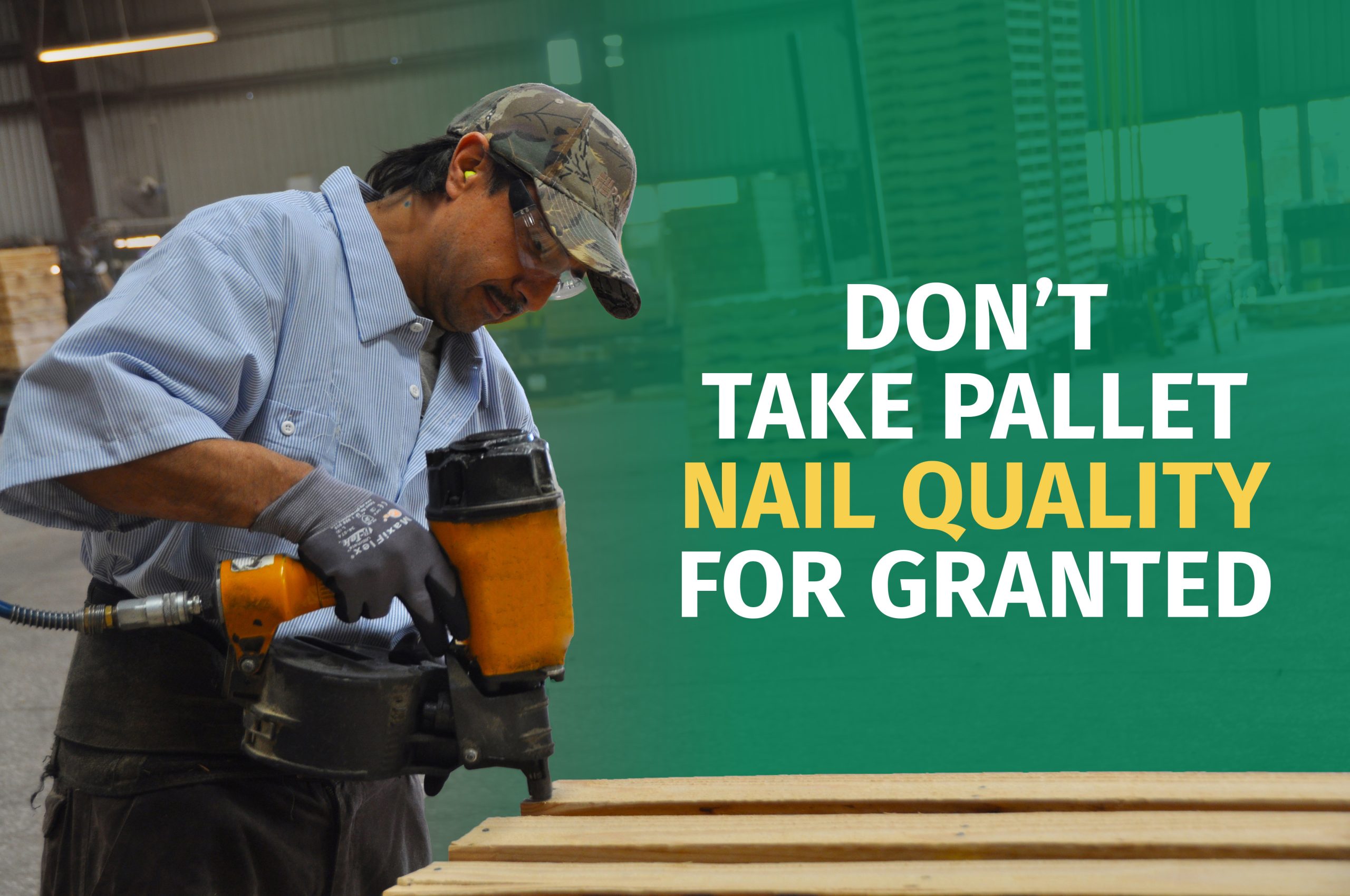
Out of sight can mean out of mind, but out of mind isn’t necessarily a good thing regarding pallet nails. While the price difference between cheaper and more expensive pallet nails is modest, a better-quality nail can make a dramatic improvement in pallet quality. Without getting too technical, in this blog, we introduce some of the basics that can be useful for wooden pallet buyers to understand.
Simply put, fasteners bind the wooden components of the pallet together. They include driven nails and staples, bolts, wood screws, and lag screws. Most wood pallets utilize one of two types of nails, including helically-threaded or drive-screw nails and annularly threaded or ring-shanked nails. During hand building, the builders drive the coil nails via pneumatic or powder-actuated nail guns.
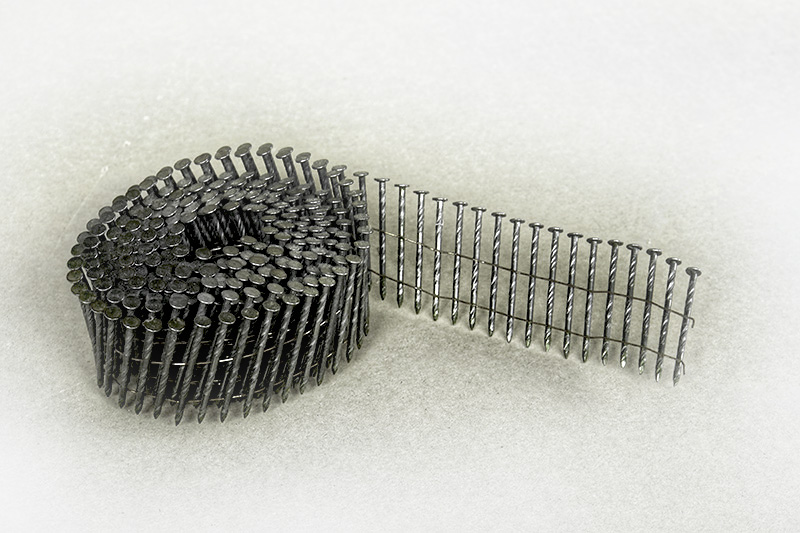
Helically threaded nails feature continuous spiral threads along the shank. Annularly threaded nails come with numerous rings along the shank that help grip the wood and prevent nail withdrawal. Of the pair, helically-threaded or drive-screw nails are the most popular choice for automated pallet assembly. Both types, however, are widely used by wood pallet manufacturers.
Annular nails offer better resistance to withdrawal and, for this reason, are often recommended for low-density hardwoods and most softwoods. Helical nails of the same gauge, though, provide better bending resistance and are therefore recommended for medium and high-density hardwoods. Bent nails can result in deck board splits, leading to the deck board being pulled through the nail head, a failure known as “pull-through.”

Pallet & Crate Assembly Fasteners
According to Virginia Tech, pallet joint failure is related to fastener withdrawal resistance and fastener shear resistance. Both of these damage factors are directly influenced by fastener quality. Withdrawal resistance speaks to the ability of the nails to secure the deck board to the stringer or stringer board and block and thus prevent separation of the deck board. According to Virginia Tech, fastener withdrawal resistance is most affected by wire diameter, the difference between thread diameter and wire diameter, and the number of helices per thread length.
Shear resistance, on the other hand, pertains to horizontal impact and displacement of the deckboard. Impact from forklift tines, for example, can drive a deck board inward, pushing it away from the ends of the stringers.
The Morgan Impact Bend Angle Nail Test (MIBANT) is used by industry researchers and professionals to predict fastener performance in use. Fasteners are measured according to nail shank length and width, thread angle and type, as well as nail head size and shape. Fasteners are tested to determine how much force it takes to bend them and how much force it takes to pull them out after they’ve been driven into wood. The more force that is required to bend or pull the fastener, the stronger that fastener is, which helps contribute to a more durable pallet.
Pallet Durability and Repair
Determining when a pallet needs repairs is essential to maintaining its performance and extending its service life. A foundational 1984 study by Wallin & Whitenack introduced a model to evaluate the optimal time for pallet repair. This model was built on data collected through the USDA’s Pallet Exchange Program (PEP) conducted from 1967 to 1971 (Wallin et al., 1972). The study focused on 17 different types of stringer pallets, which were tested across 16 varied handling environments.
The collected data included the total number of handling, damage locations, frequency of damage, and the relative severity of damage after each trip. Using this information, the researchers developed a classification system documenting nine levels of damage severity. According to the findings, pallets should ideally be repaired once they reach damage severity level 7 or higher. This ensures they maintain their durability and operational efficiency.
At PalletOne, we understand the importance of maintaining pallet quality. Our Pallet Repair Programs are designed to help businesses minimize downtime and reduce costs. From expert sorting and quality repairs to on-site management solutions, we provide comprehensive services tailored to your specific needs. Explore how our solutions can improve your operations and keep your pallets in excellent condition. Check out our Pallet Repair Programs.
The Importance of Nails and Fasteners in Pallet Manufacturing
The article by Virginia Tech underscores the value of modest improvements in nail quality. To demonstrate the impact of fasteners on pallet quality, the authors compared the performance of 11.5-gauge bulk nails with 12.5-gauge collated nails in a standard GMA pallet using Best Load™ pallet design software. Gauge refers to wire thickness, with the smaller gauge denoting a thicker nail.
Results demonstrated that pallets built with better quality 11.5-gauge nails exhibited considerably better durability than the 12.5-gauge. They lasted twice as many shipping trips before needing repairs and twice the number of trips before the pallets needed to be replaced. The wooden pallets manufactured with 11.5-gauge nails exhibited lower damage rate values and relative damage severity. Based on results, the 11.5-gauge nails were determined to result in 85.6% more durable pallets than those built with 12.5-gauge nails while doubling pallet life.
Don’t take pallet nails for granted. When it comes to improving nail quality, a little investment can mean a lot. Fastener withdrawal resistance and shear resistance are both critical to pallet durability, and durability can be dramatically improved through the use of better-quality fasteners.
Quality fasteners are a key element of PalletOne’s overall commitment to manufacturing durable and reliable wooden pallets at each of our 90+ nationwide locations. Whether it’s setting up a pallet recycling program or handling your national packaging needs in comfort with our Pallet Concierge® service, PalletOne is the pallet partner your business needs. Call us today to get started.
Pallet Nails FAQs
What is pallet quality?
Pallet quality refers to the durability and performance of the pallet and whether it was built to specification using proper materials and techniques.
What are the different types of pallet nails?
Helically-threaded nails: These have continuous spiral threads along the shank, offering better bending resistance and making them ideal for medium and high-density hardwoods.
Annularly-threaded nails: These have numerous rings along the shank, providing better resistance to withdrawal, making them suitable for low-density hardwoods and most softwoods.
How to nail pallets together
To nail pallets together effectively:
- Use high-quality nails, such as helically-threaded or annularly-threaded nails, depending on the wood type.
- Ensure proper nail placement to secure the deck boards to the stringers or blocks.
- Consider factors like nail shank length, width, and thread type to maximize withdrawal and shear resistance, which are critical for pallet durability.