
When it comes to purchasing pallets, not all wood is equal. As a pallet purchaser, you might not think about it until it becomes an issue. For example, a shortage of hardwood and a leap in price might lead your regular pallet supplier to suggest substituting a softwood pallet. Would that be a prudent step for your company? It all depends. In this article, we’ll cover the basics of lumber species, their performance, and considerations for making a switch.
Characteristics such as strength, durability, availability, and cost all come into play when determining which species will be the best choice for your pallets. The good news is that expert pallet manufacturers such as PalletOne are adept at finding the best value solution to meet your needs, even if it means helping you navigate a switch to a different lumber species.
The Big Move to Softwood
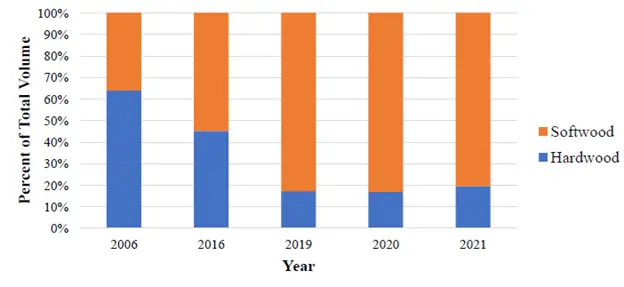
If you have already changed to softwood pallets, you are in good company. There has been a dramatic shift as hardwood supplies have dwindled and more softwood has become available, especially in the Southeast. Recent research by Virginia Tech has shown a seismic shift to softwood material. While softwood accounted for just 36% of pallet material in 2006, that proportion jumped to 55% by 2016 and a remarkable 81% by 2021, as shown in the graph below.
Source: Sean Hobbs, Investigation of New and Recovered Wood Shipping Platforms in the United States
Lumber Species Distribution in the U.S.
Wood species distribution in the U.S. plays a critical role in determining which types of wood are used for pallet production. Pallets are typically made from the most readily available species in a given region, which helps keep costs down and ensures a sustainable supply of raw materials.
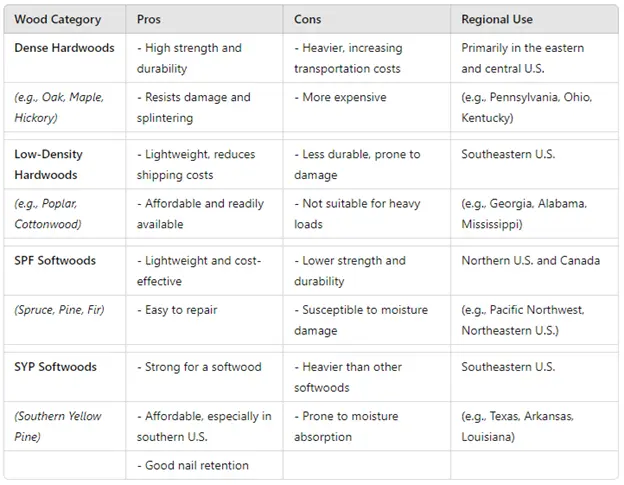
Hardwoods, such as Oak, Maple, and Hickory, dominate the abundant deciduous forests in the Northeast. These hardwoods are known for their strength and durability, making them ideal for producing heavy-duty pallets that can withstand repeated use and carry significant weight. This region’s reliance on hardwoods reflects both the tree species’ natural distribution and the manufacturing needs for stronger, more durable pallets.
The Southern U.S. offers a more diverse mix of wood species, with about 55% of forests consisting of hardwoods like Oak and Hickory, while the remaining 34% is made up of softwoods, predominantly Southern Yellow Pine (SYP). Southern Yellow Pine is especially popular in pallet production due to its high strength for softwood and its affordability and availability in the region. Pallets made from SYP are widely used in industries requiring durable and cost-effective solutions.
In the Midwest, the northern parts are home to hardwoods such as Birch, Maple, and Poplar, as well as softwoods like Hemlock and Pine. This region’s forests provide a mix of species that can be tailored to different pallet needs, balancing strength and cost efficiency.
Out in the West, softwoods dominate the landscape, with vast coniferous forests made up of species like Spruce, Pine, and Fir (SPF). These softwoods are lightweight and affordable, making them a popular choice for pallets used in industries where cost and shipping weight are vital considerations.
Hardwoods vs. Softwoods: Structural Differences and Other Considerations
Wood species used in pallet production are broadly categorized into hardwoods and softwoods. Hardwoods are typically deciduous, meaning they lose their leaves annually. They are generally denser and stronger than softwoods, which are generally evergreens that retain their foliage year-round. Softwoods have a simpler, uniform cell structure that makes them easier to work with but less dense and strong compared to hardwoods.
Moisture content is another key factor. Wood contains two types of water: free water, which is easily removed, and bound water, which is harder to eliminate. The point at which wood no longer contains free water but retains bound water is called the fiber saturation point, typically around 19% moisture content. Drying wood below this level, especially softwood species through kiln drying, makes it stronger and more dimensionally stable, but this process can increase costs due to the energy required.
Are You Ready to Make the Jump?
With your company’s reputation riding on the pallets you specify, due diligence is critical. If you are considering a change, be sure to bring key operations and supply chain leaders into the conversation, and work with your pallet supplier. Consider an onsite visit. Likewise, prototyping and testing can help ensure your new pallet checks all the boxes.
Shifting from hardwood to softwood pallets requires careful consideration of design adjustments and material use to maintain performance and durability. By collaborating closely with your pallet supplier, you can ensure that the new softwood pallets meet their operational needs while optimizing costs and ensuring durability. Regular communication and testing will be critical to a successful transition.
If you are looking to make a switch, why not contact PalletOne? We have already helped many customers convert, and our expert team has the experience to ensure your conversion is successful.