In the intricate ballet of global logistics and supply chain management, one performer has quietly held the stage for over a century, playing a pivotal yet often overlooked role.
The wooden skid, a simple construction that has evolved to become a heavyweight of transportation and storage, carries a history as rich and layered as the industries it serves.
This post will explore the fascinating history of the wooden skid, shedding light on its critical contributions to various supply chains and examining how its design and usage have transformed over the years to meet the changing needs of a dynamic global economy.
The evolution of skids
Skid-like timber and log structures used to transport materials go back several centuries. While this is an interesting bit of trivia often mentioned about skids, it is, in fact, unrelated to the evolution of the modern skid, which came into prominence in the early decades of the 20th century. The predecessors of modern skids were used to move materials and work-in-process within shops by the late 19th century. By the 1920s, they had become valued for stacking unit loads by lift trucks – at least until the development of the pallet in the 1930s.
Imagine a lift truck operator having to balance precariously outside their truck to place dunnage blocks between unit loads. That’s the way it was before the use of skids. Thanks to the development of the modern skid – a platform with a top deck fastened to stringers- the operator could remain safely in the truck while stacking or unstacking loads.
The skid was a clear improvement, but it still had limitations. It could be prone to lateral stringer collapse, and because of the extremely limited bottom coverage, it could only be used where crushing of the load below was not an issue. The invention of the double-face pallet was a direct response to the skid’s shortcomings.
The construction of the skid
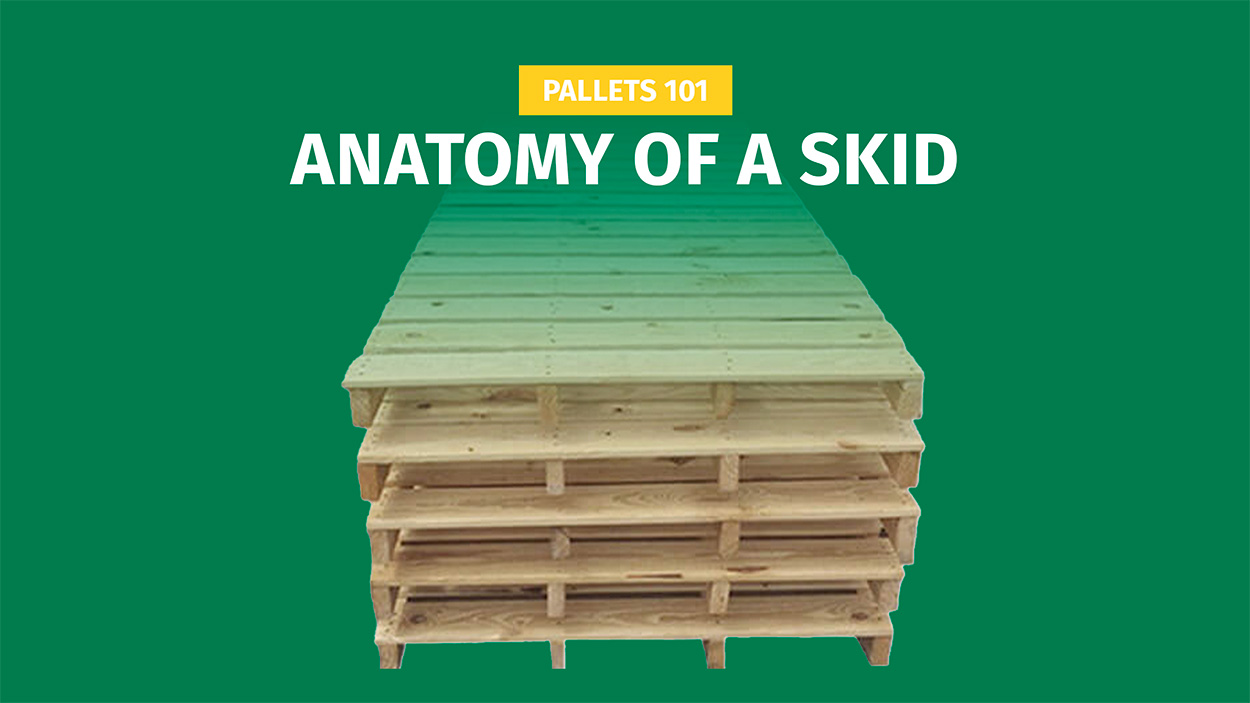
The skid consists of a top deck attached to a superstructure. In the case of the wood skid, it typically consists of the top deck boards or an engineered wood sheet fastened to stringers. A skid is also referred to as a single-face or single-deck pallet. While lighter-duty skids are typically fastened with nails, heavy-duty skids may utilize carriage or lag bolts, depending on the application.
Skids are also made from other materials, such as plastic and paper. Nestable plastic skids are commonly used in downstream retail distribution or by the US Postal Service, applications where stacking or racking is unnecessary. Unlike wooden skis, molded plastic skids typically have nine posts rather than stringers. Similarly, simple paper pallets can feature a solid corrugated or hexagonal top deck with glued blocks. Again, such pallets are suitable for lighter unit loads where pallet strength in handling environments is not a significant concern.
The benefits of the skid
The skid has several attractive features. Because it has no bottom deck, it requires less lumber and fewer nails. As a result, it is lighter and more inexpensive than a double-face pallet that might be used in its place. Also, unlike double-face pallets, empty skids can be alternated between upward and downfacing to increase the number of units in a stack dramatically. Where applicable, the skid base also facilitates easier sliding of the unit load across surfaces, compared to double-face pallets.
Where skids are used
Skids are often used in extremely heavy-duty applications such as for HVAC and other heavy equipment, sheet metal, metal coils, bundles of baling wire, bricks and blocks, and more. They are also used for less demanding loads such as sod.
And getting back to skids for metal products, PalletOne can manufacture skids using UFP Packaging’s BarrierWood™ Corrosion-Resistant Lumber (CRL), a proprietary product designed to replace hardwood lumber that has historically been wrapped in VCI film and plastic sleeves to prevent corrosion on steel.
The bottom line is that the skid, like the alligator and the sequoia, is more than a survivor. The skid is a valued contributor to PalletOne’s product line. Whether your interest is skids, pallets, or addressing other wood packaging challenges, we are here to help. Why not reach out to PalletOne’s national sales team today?