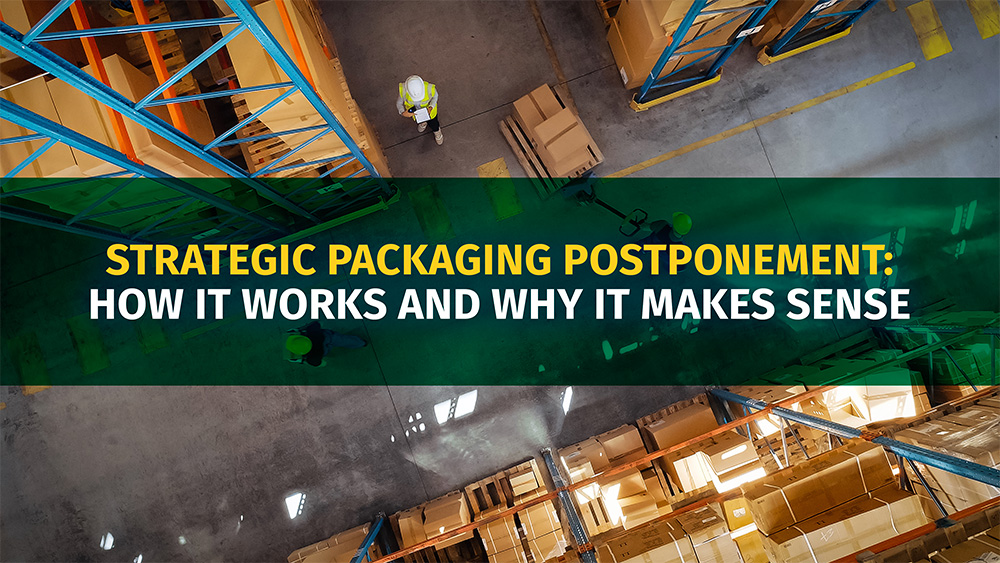
Is procrastination a strategy? It just might be! Although the concept of packaging postponement (also referred to as ‘late-stage customization’) is not new, it is one that still has not received the popularity it deserves. However, it has gained traction in recent years thanks to its potential to enhance responsiveness, minimize holding inventory, and reduce overall costs.
In recent years, for example, it has become increasingly popular in the pharmaceutical industry, where country-specific labels and instruction language are not added to pill containers until orders arrive from a particular country for the product. It is a move that can help minimize inventory requirements rather than creating stocks of SKUs for various countries at the time of manufacturing.
Aside from pharmaceutical, packaging postponement is employed regularly in sectors such as automotive assembly, international electronic device shipment, retail displayers and more. But what exactly is packaging postponement, and how can it be a winning approach for supply chain decision-makers?
Understanding Packaging Postponement
Packaging postponement is a strategy where the final packaging of a product is delayed until the latest possible stage in the supply chain. Instead of packaging products in their specified manufacturing assembly line format or in their eventual retail packaging at the point of manufacture, they are transported and stored and possibly shipped to a secondary location in a bulk bin, for example, or a semi-finished state. The final pack is completed closer to the time (and sometimes the place) of delivery, often in response to specific manufacturing or retail requirements.
Historical Context
The concept of postponement in supply chain management isn’t exactly new, although it didn’t initially pertain to packaging. That would come later. According to researchers, the practice dates back to the 1920s. The term “production postponement’ was coined by Alderson in the 1950s and elaborated upon by other researchers such as Zinn and Bowersox in the 1980s. Initially, the focus was on manufacturing postponement, where the final assembly of a product is delayed. Packaging postponement emerged as an extension of this principle, focusing on the final packaging process.
Pros of Packaging Postponement
Packaging postponement can offer several benefits. For example:
Decreased logistics costs: Postponement can help reduce freight and storage spending. Some manufacturing plants require kits of assembly parts for a particular car model build, for example. While kits enhance the speed and accuracy of production (assemblers can visually verify no part was forgotten), parts may be less densely packed and, therefore, inefficient to ship a considerable distance. Freight costs can be reduced by shipping parts densely in bulk packaging and then putting together the kits at a value-added facility close to the assembly plant. The same can hold true for building retail displays on quarter pallets (add link), which, with the quarter pallet doubled up on a full pallet, can be less efficient for shipping great distances. Consumer goods arriving in full unit loads can be assembled to build display pallets closer to the retail distribution center.
Increased Flexibility and customization opportunities: Further to the display pallet example immediately above, postponement can give brands the freedom to customize display pallets to meet the requirements of various retailers. Perhaps some stores need a half-pallet display, while others only merit a quarter-pallet option. Additionally, there might be requirements for mixed SKU pallets in different proportions to address regional market variation. Companies can quickly adapt to changes in market demand or customer preferences without the need to rework already packaged goods.
Inventory and Waste Reduction: By storing products in a generic state, companies can reduce the variety of finished goods inventory, leading to lower inventory holding costs. Because product differentiation takes place later in the supply chain, there is less pipeline inventory in its final packaging format, translating into Less risk of obsolete inventory and, correspondingly, less waste. It also allows for more efficient use of packaging materials.
Cons of Packaging Postponement
There are challenges to consider, however. These include:
- Complexity: It will add complexity to the supply chain, requiring sophisticated planning and coordination.
- Infrastructure Investment: Implementing packaging postponement may require investment in additional facilities or packaging equipment closer to the point of sale.
- Potential for Delays: Given the more complex supply chain, including downstream packaging operations closer to the point of sale, any risk of delays in final delivery must be managed.
Examples of Successful Applications
There are several successful examples of packaging postponement in the industrial and retail sectors. For example, Hewlett-Packard (HP) famously applied packaging postponement in its printer supply chain. By delaying the final packaging, HP could adapt the product manuals and power supplies to different regional standards without having to store multiple versions. Additionally, initial storage and international shipment could be done more cost-effectively in bulk containers.
Other examples include Benetton and Dell. Benetton, the clothing company postpones the final dyeing of its garments. By manufacturing them in a neutral color, Benetton can respond to fashion trends and market demands by dyeing the clothes in the most popular colors later in the season. Dell Computers utilized a form of postponement by delaying the final assembly of its computers. This allowed them to customize each computer based on individual customer specifications.
In conclusion, packaging postponement offers a strategic approach for businesses to enhance supply chain flexibility, responsiveness, and efficiency. While it may introduce additional complexities and require infrastructure investments, the potential benefits in terms of inventory reduction, waste minimization, and customization opportunities are significant. As demonstrated by companies like HP, Benetton, and Dell, successful implementation of packaging postponement can deliver a competitive advantage. If you are thinking of exploring the possibility of a packaging postponement initiative, why not contact PalletOne for a unit load packaging review?