Wooden pallets are at the heart of logistics and supply chain management, providing the foundation for moving goods safely and efficiently around the world. While they might look simple, these platforms are carefully engineered for performance and reliability. Among the most common designs in North America is the wooden stringer pallet.
This guide will walk you through everything you need to know about the stringer pallet, from its anatomy and benefits to how it compares with the versatile block pallet. You’ll also see why both options are important components of a modern supply chain.
What Is a Stringer Pallet?
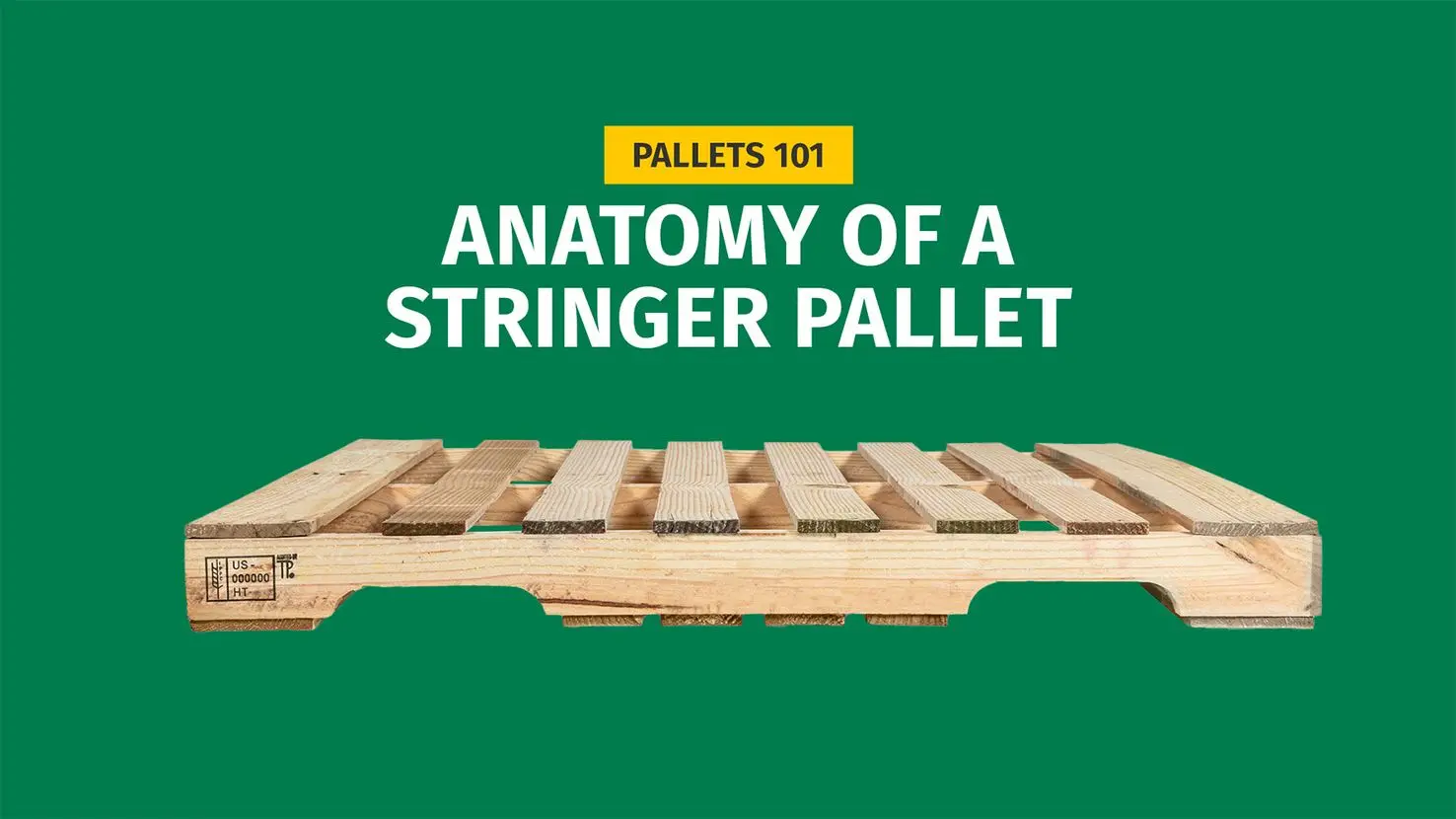
A stringer pallet features boards called “stringers” running between the top and bottom decks. These stringers serve as the backbone or main support of the pallet, distributing the load and enabling safe handling. Most standard stringer pallets include three stringers, but this number can be adjusted to accommodate heavier or specialized loads.
Stringer pallets are sometimes referred to as “two-way” pallets since forklifts can typically access them from only the front or back. However, many stringer pallets have notches cut into the stringers to allow for partial four-way entry, so forklifts can access them from the sides as well. This flexibility helps users adapt to different warehouse layouts and handling equipment.

The Anatomy of a Stringer Pallet
Understanding the components of a stringer pallet highlights the engineering that makes these pallets dependable and customizable. The main parts are top deck boards, stringers, bottom deck boards, and fasteners.
Top Deck Boards
The top deck boards make up the flat surface for cargo placement. They generally range from ⅜” to ⅝” (or more) in thickness and are available in a variety of widths. Whether you require standard sizes or custom dimensions, PalletOne can tailor the materials to match your load requirements.
Proper placement of deck boards matters, too. Positioning the boards to line up with the strongest corners of your boxes maximizes support for stacked loads. Doubling up on lead boards at each end can notably improve pallet durability, further protecting your products.
Wooden Stringers
As the principal support beams, wooden stringers run perpendicular to the deck boards, distributing the load and lending stability to each pallet. While three is typical, adding more stringers can help support heavier or unevenly distributed products. Our team can help determine the optimal configuration for your application.
For even greater strength, “wing pallets” move the stringers inward, shortening unsupported spans and boosting durability—all without requiring more raw material.
Bottom Deck Boards
The bottom deck boards provide a stable base, crucial for supporting goods on conveyors or when pallets are stacked. In stringer pallets, all bottom boards run in the same direction. Having enough coverage here ensures weight is distributed evenly and product integrity is protected during storage or transit.
Our designs ensure the bottom deck fits smoothly with conveyor rollers for efficient movement, and we can adjust the configuration to fit your workflow.
Pallet Fasteners
Reliable fasteners bind each stringer pallet together. Choices include driven nails, staples, and—for heavy-duty needs—bolts or screws. Most often, we use either helically threaded (drive-screw) nails or annularly threaded (ring-shank) nails, both of which provide excellent grip and structural stability.
Benefits of Using Stringer Pallets
Stringer pallets remain a favorite for many supply chains and industries thanks to several key advantages:
- Cost-Effectiveness: Their simpler construction often makes stringer pallets a budget-friendly choice for many companies, especially when production scale or replacement is a factor.
- Durability and Repairability: These pallets stand up well to the rigors of regular use. If damaged, individual boards or stringers can be replaced with ease, extending the pallet’s operational life.
- Customization: With flexibility in size, stringer count, and board thickness, stringer pallets can be tailored to meet the needs of a wide variety of products and industries.
Stringer Pallets vs. Block Pallets
When you need a robust, flexible pallet solution, you may also consider block pallets. At PalletOne, we manufacture both block and stringer pallets, so we can guide you toward the best fit for your unique requirements—never favoring one type over the other, but rather focusing on your application.
Here’s a quick side-by-side look at their characteristics:
Feature
Stringer Pallet
Block Pallet
Design
Uses continuous stringer boards for support.
Uses nine separate wood blocks to support the deck boards.
Entry
Two-way (can be notched for partial 4-way).
True four-way entry for forklifts and pallet jacks.
Durability
Strong and reliable for most applications.
Also highly durable, often used for heavier loads.
Cost
Often more economical for many operations.
Generally higher due to added complexity and materials.
Sustainability and Stringer Pallets
Sustainability is a top priority at PalletOne, and both our stringer and block pallets are crafted with the environment in mind. Wood is a renewable, recyclable resource, and our industry is a leader in efficient material usage and recycling.
Stringer pallets, in particular, lend themselves well to repair and reuse. When a pallet is too worn for repair, its components are often reclaimed for remanufactured pallets. Any remaining wood is repurposed as mulch, animal bedding, or even biofuel. This closed-loop approach minimizes waste and reduces environmental impact—important steps toward a more sustainable supply chain.