
As the solar energy market expands in the United States to meet the urgent demand for clean energy, so does the importance of effective packaging and handling of solar panels. These delicate devices are crucial for harnessing renewable energy but are also sensitive and expensive. They can be easily damaged if not properly protected.
With the U.S. solar market booming and future growth projections remaining strong, the packaging industry faces increasing pressure to innovate and provide solutions that ensure the safe transport and installation of solar panels. Partnering with a premier packaging provider, like PalletOne, can be the difference between success and catastrophe. Let’s explore key trends in solar panel packaging, the impact of damage, and the latest innovations designed to protect these valuable assets.
The Solar Panel Market in the U.S.: Growth Projections
The U.S. solar industry has experienced tremendous growth over the past decade. In 2023 alone, the country installed 32.4 gigawatts (GW) of solar capacity, a 37% increase from the previous record set in 2021 and a 51% increase from 2022. Experts expect this rapid expansion to continue as the U.S. pushes towards more sustainable energy solutions and solar technology becomes increasingly cost-effective.
Projections show the U.S.’s total solar capacity growing to 673 GW by 2034, enough to power more than 100 million homes. As solar adoption spreads across residential, commercial, and industrial sectors, efficient and reliable packaging solutions will become crucial.
Few packaging providers are prepared to meet the rising need for solar pallets and the required protective packaging needs of this growth industry. PalletOne has the geographic breadth and industry expertise required to meet this rising demand and protect solar panels from damage in transit.
The Cost of Damage: Financial Impacts and Risks
Solar panels, while designed to be durable and withstand harsh environmental conditions, are inherently sensitive. The silicon cells that convert sunlight into electricity are fragile and easily damaged by rough handling, improper packaging, or inadequate protection during transportation. Common types of damage include microcracks in the cells, glass breakage, edge chipping, and connector damage. Even minor damage can significantly reduce a panel’s efficiency, leading to costly repairs or replacements.
The financial impact of such damage can be substantial. A single damaged panel not only diminishes the overall efficiency of a solar array but also increases the total installation cost. Replacing damaged panels leads to additional expenses, including the cost of new panels, labor for reinstallation, and potential delays in project timelines. In large-scale installations, where thousands of panels are involved, even a small percentage of damaged panels can result in significant financial losses.
PalletOne’s comprehensive range of solar panel pallets, in both block and stringer style, are designed to supply solar panel producers with the precision and efficiency required to keep their product safe through every step of the supply chain.

The Solar Panel Handling Chain: Risks and Considerations
The journey of a solar panel from the manufacturing facility to the installation site involves several critical touchpoints where damage is most likely to occur. Understanding these stages is key to developing packaging solutions that minimize risks.
- Packaging: After manufacturing, panels are carefully packaged using protective materials such as foam inserts, padded corners, and shock-resistant solar pallets. This initial packaging is crucial for preventing damage during subsequent handling and transportation.
- Loading and Unloading: Panels are most vulnerable when loading onto and unloading from trucks. Improper stacking, rough handling, or inappropriate equipment can lead to cracked glass, chipped edges, or other types of damage. This stage requires meticulous attention to detail to handle panels carefully.
- Transportation: Solar panels are subjected to vibrations, shocks, and temperature fluctuations in transit. Packaging systems must be designed to absorb these forces and protect the panels from moisture, which can lead to long-term damage, such as corrosion.
- Storage: Improper storage, such as stacking panels in unstable conditions or exposing them to extreme temperatures, can also result in damage. Packaging systems should include features that facilitate safe storage, such as stable stacking capabilities and moisture-resistant materials.
- Installation: Panels are again handled at the installation site, and any mishandling can lead to final-stage damage just before they are mounted. This stage requires careful coordination and proper equipment to ensure that panels are not damaged during the final phase of their journey.
Trends in Pallet and Packaging Design: Innovations for Safe Transport
To address the challenges of transporting and handling solar panels, the packaging industry is focusing on several key factors:
- Shock Absorption: Packaging systems increasingly incorporate advanced materials that can absorb shocks and vibrations, reducing the risk of microcracks and other damage during transit.
- Pressure Distribution: To prevent damage from the weight of stacked panels, packaging designs now often include reinforced structures or protective layers that evenly distribute pressure across the panels.
- Moisture and Temperature Control: Solar panels are sensitive to moisture and temperature fluctuations, so modern packaging solutions include moisture-resistant barriers and insulation to maintain a stable environment.
- Efficient Cube Utilization: Space optimization is critical for cost efficiency. Packaging systems are designed to maximize the number of panels per shipment while ensuring that each panel is adequately protected.
- Ease of Handling: Packaging that includes features such as handles, straps, and easy-to-understand labeling is becoming standard, making it easier for workers to load, unload, and transport solar panels safely.
Introducing Solster Solar Panel Pallet: A Superior Packaging Solution
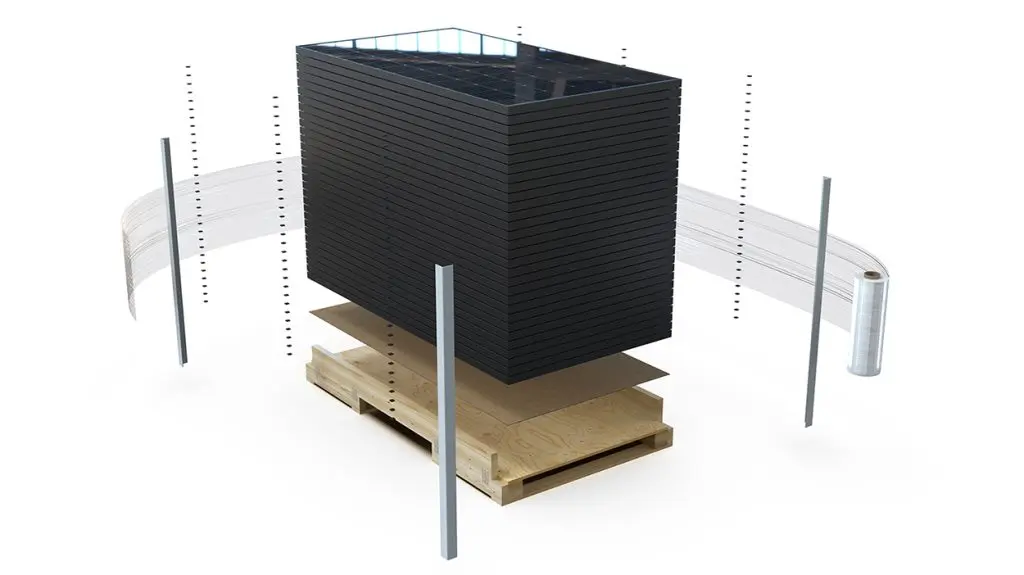
To address the challenges of solar panel transportation, PalletOne parent company UFP Packaging has developed the Solster System, a comprehensive packaging solution that ensures the safe transport of solar modules. This innovation provides cost savings, improved production time, and enhanced safety for your products and customers. It’s also reusable, repairable and recyclable.
Solster features a reinforced solar pallet design, including two additional nail-plated stiffeners. This extra support minimizes the deflection that causes microcracks, allowing for increased modules per pallet. It integrates protective packaging components such as stretch film, corrugate, corner protectors, and rubber spacers to form a total packaging solution. ISPM-15 heat treatment is available for international shipping.
For solar panel packaging decision-makers, Solster represents the best solution for ensuring that panels arrive at their destination in perfect condition to be installed and generate clean energy. As the solar industry continues to grow, investing in high-quality packaging like Solster is essential for protecting your investment and maintaining the efficiency of your solar installations. Contact the experts at PalletOne to find out how we can provide you with the best in solar panel packaging.