
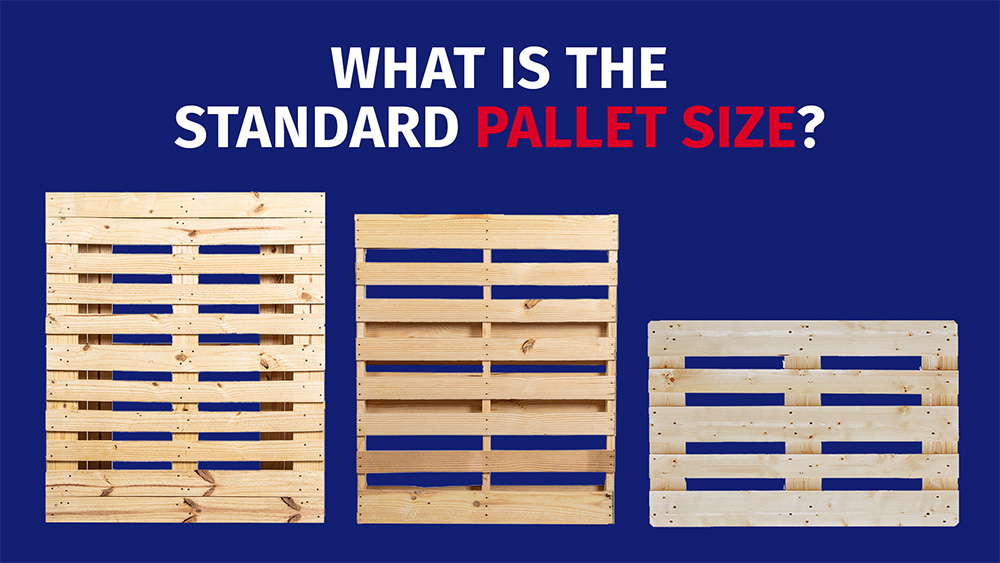
The standard pallet size is 48″x40″, with deck boards measuring 3 1/2″ wide and 5/16″ thick. The Grocery Manufacturers Association sets these specifications (GMA). However, the concept of a standard pallet specification depends on your location—whether you’re referring to North American or European pallet standards—and the industry you’re serving. While other pallet sizes vary by industry, the 48″x40″ pallet based on GMA standards is the most common, comprising over 30% of all pallets used in the United States.
This comprehensive guide will tell you what your standard pallet is and why:

Chart: The Standard Pallet Size is 48″x40″
North American Pallet Sizes
North American usage of this size is driven by the food and beverage industry. This size is also commonly used across other industries. It aligns well with door widths and truck sizes, in addition to being widely available in the used pallet market.
48″x40″ Pallets: The 48″x40″ pallet is a cornerstone in the logistics of the food and beverage industry in North America. Its dimensions align with standard door widths and truck sizes, facilitating efficient loading and unloading processes. This pallet size is also favored in the secondary market, where used pallets can be resold or repurposed, reducing costs and environmental impact. GMA (Grocery Manufacturers Association) standards heavily influence this size, ensuring compatibility across the supply chain and promoting widespread adoption among various industries beyond food and beverage.
40″x40″ Pallets: Designed specifically for the dairy industry, the 40″x40″ pallet offers a square shape that optimizes space utilization in storage and transportation. Dairy products often require stable and compact pallets to support their weight and ensure safe handling. The dimensions of 40 inches by 40 inches provide sufficient surface area for stacking dairy products efficiently, minimizing the risk of damage during transit. This pallet size is built to meet the unique logistical challenges of the dairy sector, ensuring products reach consumers in optimal condition.
36″x36″ Pallets: In the beverage industry, where products vary in weight and volume, the 36″x36″ pallet strikes a balance between size and strength. These pallets are designed to accommodate beverages such as bottled water, soft drinks, and juices, which require sturdy support during handling and transport. The square shape of 36 inches by 36 inches allows for efficient stacking and storage in warehouses and distribution centers, optimizing space and logistical operations. This size ensures that beverages can be transported safely and efficiently from production facilities to retail outlets or directly to consumers.
48″x20″ Pallets: In the retail sector, stores demand pallets that can maneuver easily within store aisles and fit through standard doorways. The 48″x20″ pallet size is specifically built to meet these requirements, providing retailers with a versatile solution for their logistical needs. This compact size allows for efficient handling and placement of goods in retail environments, enhancing operational efficiency and customer satisfaction. Whether used in grocery stores, department stores, or warehouses, the 48″x20″ pallet facilitates seamless movement of products from storage to display areas, ensuring a smooth supply chain flow.
48″x36″, 48″x42″, 48″x45″ Pallets: These larger pallet sizes serve the beverages, packaged paper, shingles, chemicals, and automotive industries, each with distinct dimensional and weight requirements. The 48″x36″, 48″x42″, and 48″x45″ pallets accommodate varying product dimensions and load capacities, ensuring secure transportation and storage of goods. Industries like beverages rely on these pallet sizes to handle large volumes of products efficiently, while chemical and automotive sectors benefit from their robust design and structural integrity. These sizes are designed to meet stringent industry standards and regulatory requirements, ensuring reliability and safety in supply chain operations.
In summary, each pallet size is meticulously designed to address the specific needs and challenges of its respective industry, ensuring optimal performance in handling, transportation, and storage of goods.
Pallet Dimensions
Industry Used
48 x 40
Grocery and other FMCGs
40 x 40
Dairy
36 x 36
Beverage
48 x 20
Retail
48 x 36
Beverage, Packaged Paper, Shingles
48 x 42
Beverage, Chemical
48 x 45
Automotive
40 x 48
Military, Cement
35 x 45.5
Military
44 x 44
Chemical, Drums
48 x 48
Drums
42 x 42
Paint, Telecom
European Pallets
In Europe, the European Pallet Association (EPAL) regulates the euro block pallet, an 800 x 1200 mm model, slightly smaller than its American counterpart. (By comparison, the GMA pallet measures 1219 x 1016 mm.) The euro pallet size is considered a standard in Europe and is popular due to its durability, standardization, and ease of exchange across various industries. According to the most recent report, it accounted for 21% of new pallet production in Europe.
EURO
Pallet Type
Pallet
Dimensions
ISO Pallet Alternative
EUR/EUR 1
800 mm × 1200 mm
(31.50” × 47.24”)
ISO1, same as EUR
EUR 2
1200 mm x 1000 mm
(47.24” × 39.37”)
ISO2
EUR 3
1000 mm × 1200 mm
(39.37” × 47.24”)
EUR 6
800 mm × 600 mm
(31.50” × 23.62”)
1100 mm x 1100 mm
(43.30” x 43.30”)
ISO0,
1/2 of EUR
600 mm × 400 mm
(23.62” × 15.75”)
1/4 of EUR
400 mm × 300 mm
(15.75” × 11.81”)
1/8 of EUR
Another variant, the 1000 x 1200 mm industrial pallet, caters to the chemical industry. The 1200×100 mm block pallet is also the standard size for consumer products in the U.K. The ‘pooling’ concept is strong in Europe, thanks to EPAL and other pallet pools.
Euro Pallet (EUR 1 – 800 mm x 1200 mm): The standard Euro pallet, measuring 800 mm x 1200 mm (31.50” x 47.24”), is regulated by the European Pallet Association (EPAL) and widely used across Europe. Its dimensions are optimized for efficient handling and transportation of goods in logistics, retail, and manufacturing sectors. Known for its durability and standardized design, the Euro pallet facilitates smooth operations in supply chains where interchangeability and reliability are paramount. In the secondary market, used Euro pallets are refurbished and resold, supporting sustainable practices and cost-effective logistics solutions.
Industrial Pallet (EUR 3 – 1000 mm x 1200 mm): The EUR 3 pallet, sized at 1000 mm x 1200 mm (39.37” x 47.24”), is specifically tailored for the chemical industry and its stringent requirements. These pallets are designed to safely transport chemical containers and drums, ensuring stability and compliance with safety standards. The robust construction of EUR 3 pallets enables them to withstand the challenges of handling hazardous materials, making them essential for secure logistics operations in chemical manufacturing and distribution.
Block Pallet (1200 mm x 1000 mm): In the United Kingdom, the 1200 mm x 1000 mm block pallet (47.24” x 39.37”) is widely used for consumer product distribution. Its size is ideal for efficient stacking and storage in retail warehouses and distribution centers. The block pallet supports the logistics needs of retail operations by maximizing space utilization and ensuring ease of handling during transportation and storage.
Why the Euro Pallet Sizes Are Significant:
Size Comparison: Euro pallet dimensions, such as 800 mm x 1200 mm, reflect the use of the metric system in Europe, while North American pallets, like the GMA pallet (1219 mm x 1016 mm or 48” x 40”), are based on imperial measurements. The slight size difference is primarily due to these measurement conventions, impacting pallet design and compatibility with regional logistics infrastructure.
Popularity and Usage: The 1219 mm x 1016 mm GMA pallet is widely adopted in North America, particularly in food and beverage industries, due to its compatibility with standard door and truck dimensions. In contrast, the Euro pallet’s 800 mm x 1200 mm size is favored in Europe for its standardized dimensions and efficient use within the European logistics network. It supports seamless cross-border trade and logistics operations, enhancing supply chain efficiency and cost-effectiveness.
Considerations for International Trade:
Buying Euro Pallets in America: Businesses importing Euro pallets into America must ensure compliance with EPAL standards and International Standards for Phytosanitary Measures (ISPM 15). This regulation requires pallets to undergo heat treatment or fumigation to prevent the spread of pests during international transport. Ensuring compliance helps avoid delays and additional costs associated with customs clearance.
Buying American Pallets for Europe: When sourcing American pallets for use in Europe, companies should consider EPAL regulations and compatibility with European logistics infrastructure. Non-compliant pallets may face challenges in meeting local standards and could incur additional costs or delays in distribution and transportation operations.
Understanding the specific dimensions, applications, and regulatory standards of Euro pallet sizes is crucial for businesses engaged in international trade and logistics. Each pallet size is meticulously designed to meet industry-specific requirements, ensuring efficiency, safety, and compatibility across diverse markets and geographic regions.
Regulatory Influence (GMA and EPAL): GMA (Grocery Manufacturers Association) and EPAL (European Pallet Association) play crucial roles in establishing pallet standards that promote efficiency and safety in global supply chains. These organizations set guidelines for pallet dimensions, materials, and performance criteria to ensure compatibility with handling equipment and logistical systems. By adhering to GMA and EPAL standards, manufacturers and suppliers can achieve consistency in pallet design and usage, facilitating seamless operations across different industries and geographic regions. This regulatory influence helps standardize pallet dimensions, promoting compatibility and reducing operational costs associated with logistics and distribution.
Regulatory standards set by organizations like GMA and EPAL play a pivotal role in shaping pallet design and usage, fostering efficiency and reliability throughout global supply chains.
Popular Pallets Around The World
In Asia, two noteworthy pallet sizes are the 1100 x 1100 mm, widely used in Japan and other countries, and the 1200×1000. The 1200×1000 pallet has become an increasingly popular choice in countries such as China and India with modern supply chain infrastructure growth. The 1219 x 1016 mm size is popular for export, aligning with the global shipping standard of 20- and 40-foot shipping containers and its compatibility with North American customers.
In contrast to Asia’s diversity, Australia, has largely standardized around the Australian Standard Pallet size of 1165 x 1165 mm. However, an increasing amount of international trade has increased the use of Euro and GMA-size pallets too.
On the African continent, there is a significant variety of pallet sizes. However, there has been a growing move towards aligning with the Euro and GMA standard sizes, especially for international shipping.
ISO Pallets
The need for standardization goes beyond any single nation. After World War II the newly-formed International Organization for Standardization (ISO) created a series of global standards for standardization in all technical and nontechnical fields, including pallets.
Pallet Dimensions
Regions Used
1016 mm x 1219 mm
(40″ x 48″)
North America
1067 mm x 1067 mm
(42” x 42”)
North America, Europe, Asia
1000 mm x 1200 mm
(39.27” x 47.24”)
Europe, Asia
800 mm x 1200 mm
(31.5” x 47.24”)
Europe
1165 mm x 1165 mm
(45.9” x 45.9”)
Australia
1100 mm x 1100 mm
(43.3” x 43.3”)
Asia
Chemical Pallets
The chemical industry developed the CP pallet specification. The CP pallet program is overseen by PlasticsEurope, a European trade association that authorizes select companies to produce CP pallets. There are nine different models available to meet the specific needs of the chemical and polymer This pallet has a bottom deck board, which facilitates easy stacking.
Pallet Dimensions
Common Uses
Defining Factors
CP1
1200 mm x 1000 mm
(47.24” x 39.37”)
Best for boxes and bags or sacks of raw materials
These skids do not have a bottom deck board and are fitted with runners.
CP2
1200 mm x 800 mm
(47.24” x 31.5”)
Used to transport canisters, boxes, and fiber drums.
These skids have three runners.
CP3
1140 mm x 1140 mm
(44.88” x 44.88”)
Ideally suited to transporting bags, barrels, and octabins.
This is a square skid, which has three runners.
CP4
1100 mm x 1300 mm
(43.3” x 51.18”)
Designed for sacks of raw materials.
This skid has three runners and a wider lead or edge board.
CP5
760 mm x 1140 mm
(29.92” x 44.88”)
Made for transporting small boxes and cartons.
This is a smaller skid, which has three runners and no bottom deck board.
CP6
1200 mm x 1000 mm
(47.24” x 39.37”)
Best for sacks and boxes.
This pallet has a bottom deck board, which facilitates easy stacking.
CP7
1300 mm x 1100 mm
(47.24” x 51.18”)
Used to transport sacks.
These pallets have bottom deck boards, which makes stacking effortless.
CP8
1140 mm x 1140 mm
(44.88” x 44.88”)
Designed to transport sacks and octabins.
These are square pallets with bottom deck boards, which are characterized by a gap in the center for drainage.
CP9
1140 mm x 1140 mm
(44.88” x 44.88”)
Ideal for bulk containers and drums.
These are the same as CP8 pallets without the hole for drainage.
Why Do Standard Pallet Sizes Matter?
This information can seem unnecessarily complex, but the standardization of pallet sizes is integral to the easy flow and optimization of nearly every supply chain worldwide. Knowing the standard pallet sizes for your industry can help you streamline pallet transport and selection, as well as reduce costs associated with having to return non-standardized pallets. This is especially true if you are shipping internationally.
The optimization of space and cost efficiency benefits everyone in the supply chain from manufacturer to consumer. Standardizing pallet sizes makes sure your products fit in trucks, warehouses, and other locations along the way. This helps reduce shrinkage and damage to goods while optimizing transport costs.
Even if you are using a custom pallet, internal standardization matters as well. Standard pallet specifications enable the optimization of all your material handling equipment to align with a single platform. This optimization extends to warehouse storage and transportation, allowing you to maximize the number of pallets on a truck or in your storage space.
Furthermore, if your production processes involve automation, the use of standard-sized pallets ensures a seamless flow throughout the line, eliminating the need for adjustments due to varying pallet sizes.
Setting The Right Standard For Your Product
While standard sizes make freight and reuse less complicated overall, one-size-fits-all does not always apply to pallets. The best pallet is almost always the pallet designed specifically for your product.
Custom pallets usually come with a higher price tag, but that investment pays off in the form of increased reliability and decreased product loss while also protecting your employees from the dangers of an ill-suited, unstable pallet.
Our Unit Load Design experts don’t just take your product and your pallet into consideration. They look at everything: shipping methods, storage conditions, pallet re-use needs, other packaging supplies like shrink wrap or corrugated stabilizers, and more, to give you a total packaging solution to provide you an optimized packaging solution.
Partnering with a supplier who does a proper packaging consultation is key to determining if a standard pallet can properly meet your needs. PalletOne’s Pallet Concierge® program takes this a step further, finding the perfect pallet for your product and giving you full access to the first wholly owned national pallet supplier with a single, easy-to-reach point of contact.
Contact us today to find out how Pallet Concierge® can solve your pallet problems.
Common Pallet FAQs
How tall is a standard pallet?
A standard GMA pallet’s height is 4.75” tall before being stacked with boxes.
How much does a standard pallet weigh?
Standard pallet weight varies, generally between 30–48 lbs.
How much weight can a standard pallet hold?
A standard GMA pallet can support up to 4,600 lbs.
How much do shipping pallets cost?
Shipping pallet costs depend on factors like material, size, product type, and location. Use our online quoting tool to get free quotes for pallet shipments today.