Sam’s Club has recently updated its inbound pallet requirements: all inbound pallets must now be block pallets, effectively eliminating GMA stringer-style pallets from its domestic supply chain. While most pallets flowing into Sam’s Club were already aligned with this direction, the new formal policy solidifies the requirement and raises the stakes for compliance.
Understanding the Sam’s Club Block Pallet Requirement
According to Sam’s published guidelines, all suppliers must ship on 48” x 40” nine-block pallets. Both pooled and white-wood pallets are permitted, but all pallets must meet or exceed grade-A specifications and pass detailed structural standards. Sam’s Club does not accept stringer pallets, CHEP Europe designs, or corrugated/paperboard pallets for domestic orders.
Key Pallet Requirements:
- 48” x 40” nine-block configuration with full four-way entry
- No cracks >1/8” wide and 15” long on deck boards
- Flush or countersunk nails only
- Prohibits the use of false bottoms, pallet skirts, stapling/gluing product to pallet
- Top deck boards: Four 5.5” and five 3.5” wide boards (all 5/8” thick)
- Bottom deck: Two 5.5″ x 40″ and three 5.5″ x 37″ boards (5/8″ thick)
- Blocks: Nine solid wood blocks of specified dimensions
- Maximum pallet weight (loaded): 2,500 lbs for iGPS/standard pool pallets
Non-compliance may result in chargebacks or fees, and Sam’s encourages direct coordination with its packaging and sourcing teams for global shipments.
Approved pooling providers include CHEP, PECO Pallet, RM2, and iGPS.
The Block Pallet Trend in North America and Abroad
Block pallets have long offered functional advantages over traditional stringer pallets, including full four-way entry for ease of entry in congested environments and, depending upon the bottom deck configuration, better performance in block stacking applications, conveyors, and automated systems. While stringer pallets still dominate in sectors such as construction and general manufacturing, block pallets have gained ground in food, beverage, and retail distribution.
The origins of the block pallet trace back to World War II military logistics. CHEP’s U.S. introduction of the Mark 55 block pallet in 1992 was an early turning point for North American adoption. Still, growth has been gradual. In 2011, block pallets accounted for less than 10% of U.S. new pallet production. By 2016, that figure had doubled to 21%. The most recent statistics reported its U.S. market share at 19%. While still in the minority, block pallets are now commonplace in high-throughput environments and continue to gain acceptance.
Retail mandates have played a role. Costco implemented a block pallet requirement in 2011 to better address its handling equipment needs. As automation in distribution centers becomes more widespread, the predictability and uniformity of block pallets are increasingly valued.
In Europe, block pallets dominate, accounting for nearly 70% of production across several countries. The EPAL and chemical pallet (CP) pools, as well as custom 4-way pallets, are widely used. In Asia Pacific, uptake varies, with strong block pallet usage in China and India, and stringer preferences lingering in countries such as Japan and Australia.
The Bigger Picture: Corporate Pallet Mandates and Their Impacts
Corporate pallet mandates, like Sam’s Club’s block pallet requirement, are intended to increase efficiency, safety, and compliance across retail and distribution operations. These policies help standardize the handling environment while improving automation compatibility, reducing product damage, and supporting branding expectations at the club store level. In Sam’s case, uniformity and presentation heavily factor into the decision.
However, unilateral pallet mandates are not without controversy when changes are not viewed positively by trading partners. One historical example is the Icelandic pallet standards court case from the early 2000s. In that instance, Iceland’s state-run alcohol and tobacco monopoly (ATVR) mandated that all inbound goods be delivered on EUR-standard block pallets and that the cost of the pallet be embedded in the product price.
A supplier challenged this policy in an EU court, arguing that it created barriers to competition and restricted the free movement of goods. However, the court ruled in favor of ATVR. It found that the requirement supported operational efficiency and standardized handling in the warehouse and that any additional cost could be passed on to the customer through the product price.
The court further stated that standardization typically contributes to downstream efficiencies, which can outweigh competitive limitations in the upstream market. The ruling legitimized pallet standardization mandates when justified by logistical advantages and fair cost distribution.
The same dynamics exist in North America. Large retailers often dictate a particular pallet policy, which might be a headache to suppliers but one to which they must adhere. The burden is mitigated when compliance costs can be passed through to the customer. However, smaller or export-focused suppliers may lack access to compliant pallets or pooling infrastructure, creating economic friction.
If the benefits of standardization accrue to the receiver while the sender bears the cost, resistance is understandable. Compensation mechanisms or collaborative planning should accompany major shifts in pallet expectations.
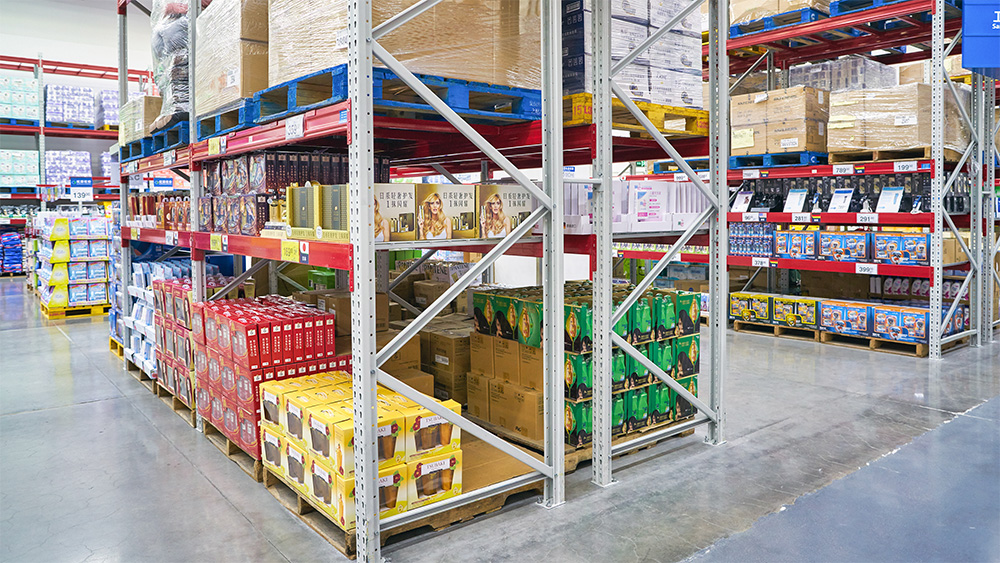
Pallets serve for transportation and display at Sam’s Club.
Practical Advice for Suppliers Navigating Pallet Policies
For suppliers facing Sam’s Club’s or other customer mandates:
- Engage Early: Involve your operations and packaging teams early to ensure compliance.
- Work with Approved Poolers: Evaluate rental vs. owned pallet economics.
- Audit Your Systems: Ensure your palletization processes, tooling, and inspection systems align with customer specs and ensure you have the flexibility to address different customers’ potentially varying pallet requirements.
- Build a Compliance Playbook: Document specs and maintain a straightforward process for tracking changes to customer requirements.
The use of corporate mandates is an imperfect tool but often necessary for supply chain alignment. The challenge for suppliers can lie in meeting these expectations cost-effectively without needless disruption.
Do you have questions? Feel free to reach out to PalletOne.